Coming soon

Versions and prices
Part numberConfigurationPrice
MP2A-35T-4MXC7A35T, 4 Mbit SRAM $250
MP2A-100T-16MXC7A100T, 16 Mbit SRAM $350
  • Educational discount: 20% for students, faculty and staff. Email edu@micro-nova.com from your .edu address for a code.
  • Ships from Waterford, Michigan
  • 90-day warranty against manufacturing defects
  • Made to order: custom builds, such as part substitutions or industrial-temperature parts, are available. Ask us

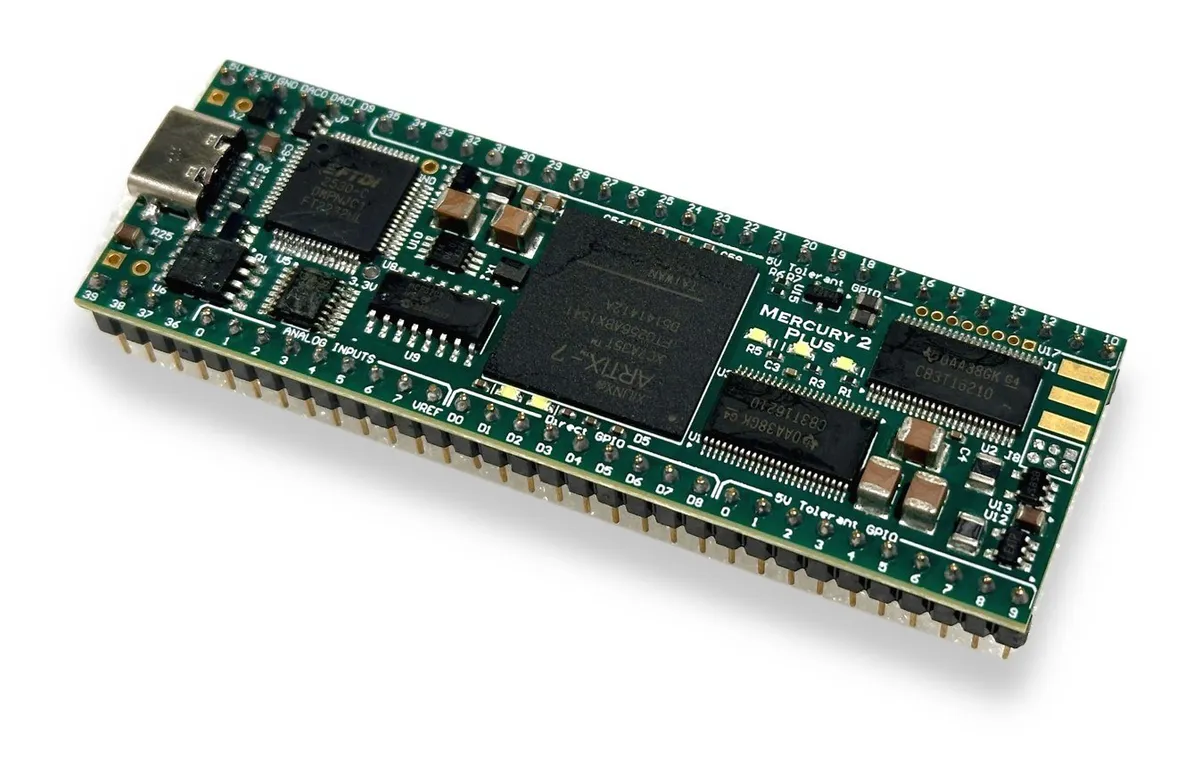
Mercury 2 Plus is the next generation of the Mercury 2 platform. It keeps the Artix-7 FPGA, in XC7A35T and XC7A100T versions, and brings next-generation analog, storage and connectivity.

What’s new

  • A 16-bit SRAM data bus. Mercury 2’s SRAM has an 8-bit data bus; Mercury 2 Plus doubles it to 16 bits, so every memory access moves twice the data.
  • USB-C. It replaces the Micro USB connector with one that’s more robust mechanically.
  • 12-bit analog. The 8-channel ADC and 2-channel DAC are now 12-bit versions.
  • Differential pairs for high-speed interfaces. The FPGA-direct I/O pins are routed as four 100 Ω controlled-impedance differential pairs, so they’re ready for high-speed interfaces such as HDMI.
  • Programs straight from Vivado. Mercury 2 Plus works with AMD’s Vivado Hardware Manager over USB, out of the box. Load a bit file directly over JTAG for a one-time run, or write it to flash for repeated or production use.

Jump-start your design

Check out these six Vivado example projects, which exercise each part of the board: a blinking LED, the ADC, the DAC, the Ethernet PHY, every I/O pin on the DIP connector, and a full SRAM self-test. Download them all under Documents and software, or one at a time from the resources page.
Specifications

FPGA
  • AMD (Xilinx) Artix-7: XC7A35T or XC7A100T
  • 50 MHz MEMS oscillator, ±50 ppm
USB
  • USB-C connector
  • FTDI FT2232H, 480 Mbps USB 2.0
  • Channel A: configuration and debugging (SPI flash programming, USB-JTAG)
  • Channel B: user-configurable high-speed link between FPGA and host
Memory
  • 64 Mbit SPI configuration and user flash
  • 4 Mbit (256K × 16) or 16 Mbit (1M × 16) 10 ns asynchronous SRAM on a 16-bit data bus
Analog I/O
  • Microchip MCP3208: 8-channel, 12-bit ADC
  • Microchip MCP4822: 2-channel, 12-bit DAC
  • Artix-7 XADC: 1 MSPS, 12-bit, on a dedicated input or mappable to FPGA-direct I/O
Digital I/O
  • 40 5-volt-tolerant I/O pins via 2× TI SN74CB3T16210 bus switches
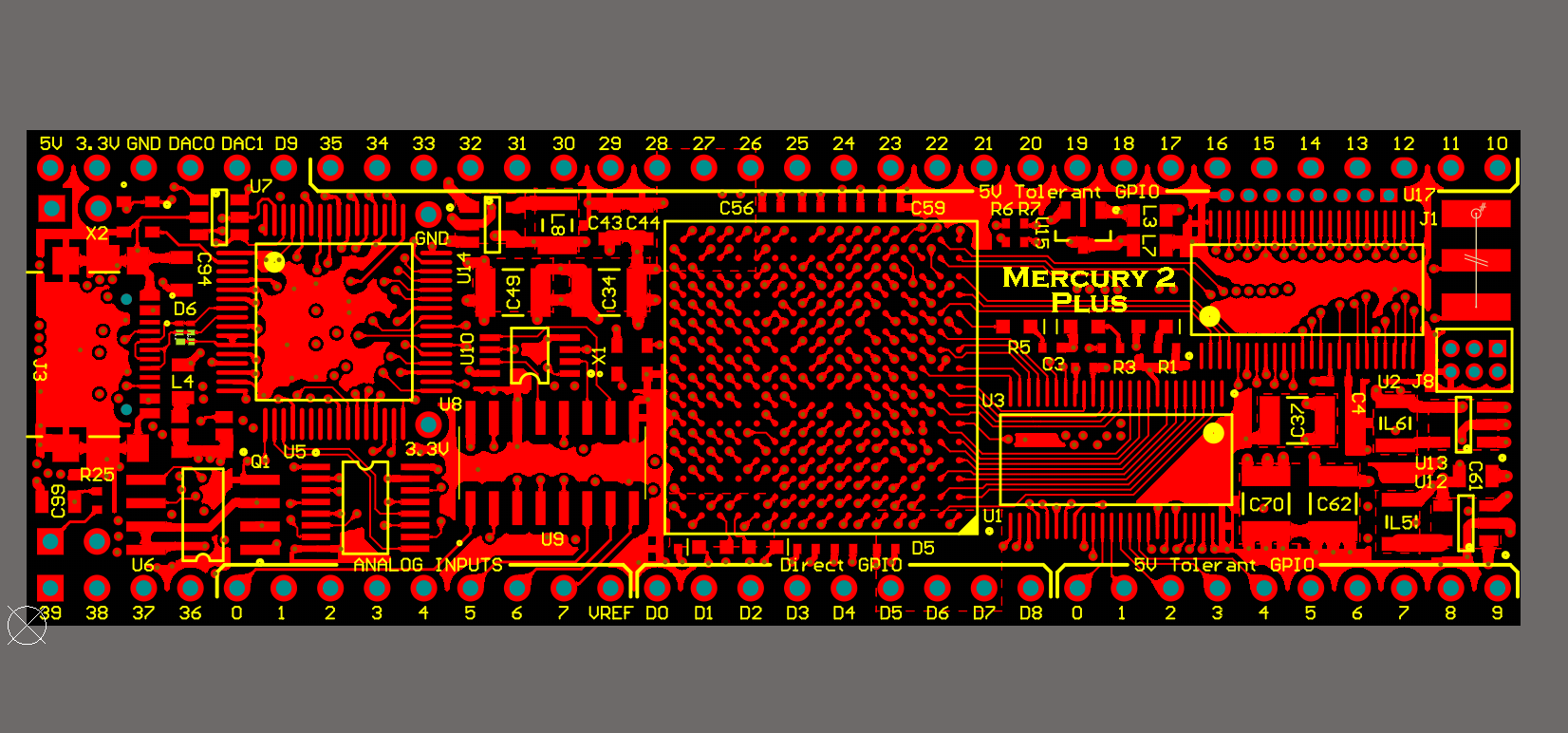
  • 10 FPGA-direct high-speed I/O pins, 8 of them routed as four 100 Ω controlled-impedance differential pairs for interfaces such as HDMI
  • 3 user LEDs
  • Microchip LAN8720A 10/100 Ethernet PHY
  • 6-pin JTAG header
Power
  • USB-C or external 4.5–5.5 V regulated supply
  • Switching regulators for the 3.3 V, 1.8 V and 1.0 V rails